
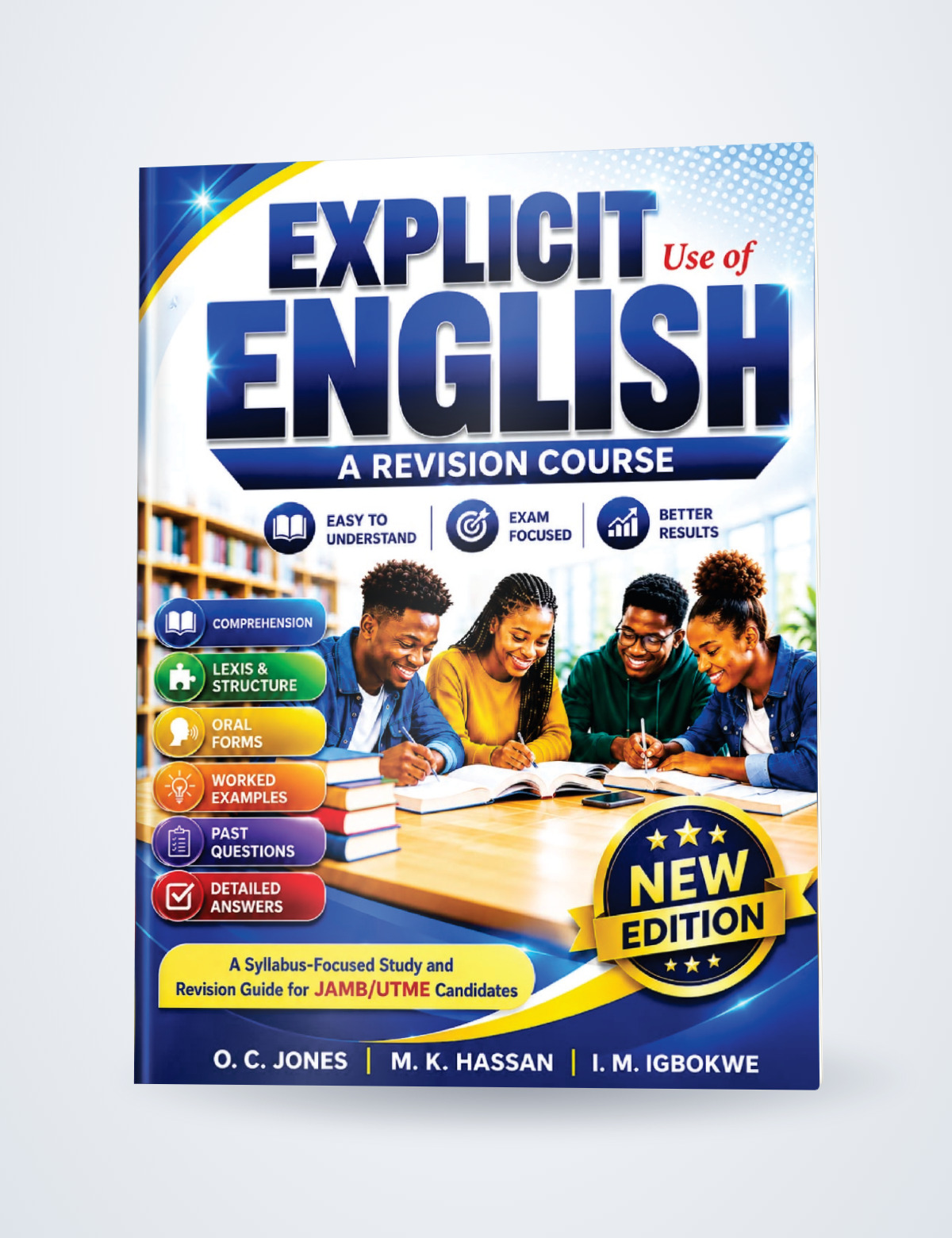
Explicit ENGLISH
O.C. JONES, M.K. HASSAN, I.M. IGBOKWE
199 pages
The first edition of Explicit Use of English was written with a simple purpose: to give candidates a practical revision companion for the language demands of the Unified Tertiary Matriculation Examination. Over time, however, both the needs of candidates and the shape of effective examination preparation became clearer. This new edition is therefore not a cosmetic reprint. It has been thoroughly reorganised, expanded and rewritten so that the book functions as a complete, coherent and syllabus-focused course in JAMB Use of English. Use of English deserves special attention because it is compulsory for every candidate who sits the UTME. Whatever course a candidate intends to study, and whatever three other subjects are selected, Use of English remains common to all. That makes it impossible to avoid and unwise to underestimate. A student may be strong in the three course-specific subjects and still lose a large number of marks in English. Poor performance in this compulsory paper can lower the overall UTME score and may become the difference between meeting and missing an admission target. For that reason, Use of English should be prepared for with the same seriousness as any other examination subject. The organisation of this edition follows the JAMB Use of English syllabus closely. Section A develops Comprehension and Summary skills: understanding passages, identifying main ideas, making inferences, interpreting tone and meaning in context, summarising and synthesising ideas, mastering the cloze test and approaching the prescribed reading text. Section B covers Lexis and Structure: sentence interpretation, synonyms, antonyms, idioms, word choice, spelling and word formation, word classes, phrases and clauses, nouns and pronouns, adjectives and adverbs, tense and aspect, mood and modals, concord, gerunds and infinitives, prepositions and conjunctions, question tags, reported speech, capitalisation and punctuation. Section C deals systematically with Oral Forms: vowels, consonants and clusters, rhymes and homophones, word stress and emphatic stress in connected speech. The 60-question paper itself is distributed across these same sections: 25 questions in Comprehension and Summary, 25 in Lexis and Structure and 10 in Oral Forms. The teaching approach has also been redesigned. Each chapter begins by stating its syllabus focus and the skills the candidate should be able to demonstrate. The explanation then moves from clear principles to worked examples, examination traps, quick checks and substantial revision practice. Chapter snapshots bring the key ideas together, while the answers and explanations to the revision questions are collected at the back of the book so that students can attempt the questions before consulting the solutions. Where suitable year-labelled UTME questions are available, they have been retained as authentic examination practice. Additional JAMB-style questions have been written to strengthen areas that need more practice or broader coverage. The aim is not to encourage memorisation of old answers, but to help candidates recognise recurring patterns, understand why an answer is correct and transfer that understanding to unfamiliar questions. Standard British English is used throughout, in keeping with the expectations of the examination. Particular care has been taken in areas where everyday speech, local usage and formal examination English may differ. The Oral Forms chapters likewise emphasise a sound-first approach: candidates are trained to hear and analyse pronunciation rather than rely on spelling alone. This book is intended for serious personal revision, classroom teaching and guided examination practice. Its central message is simple: success in Use of English does not depend on guessing or memorising disconnected rules. It comes from understanding how English works, recognising how JAMB tests that knowledge and practising until the correct patterns become familiar. Candidates who work through the chapters deliberately, attempt the exercises before checking the answers and return to weak areas should approach the compulsory Use of English paper with greater confidence, accuracy and control.
Students Also Bought
Student Reviews
Loading reviews…